
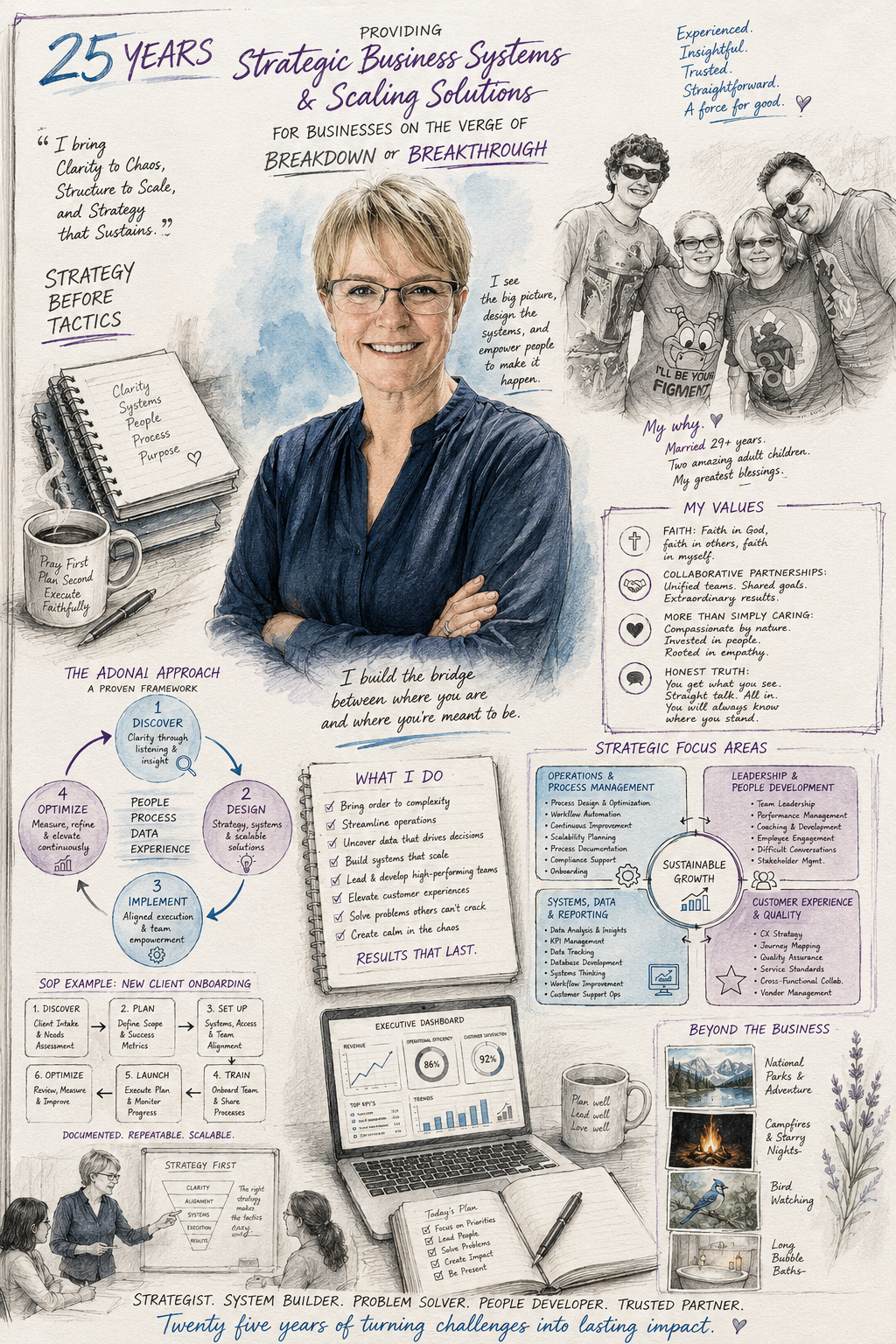
This year marks 25 years in business. A quarter century of building, breaking, fixing, and starting over. I keep waiting to feel like I have it all figured out. I don’t. What I have instead is a long list of things I’ve learned, most of them the hard way.
So instead of a polished retrospective about how far we’ve come, here’s the honest version. These are the lessons that stuck.
The cobbler’s kids have no shoes
I build operational infrastructure for a living. Systems, workflows, the behind-the-scenes machinery that keeps a business running smoothly. I love this work. I’m good at it. And for years, my own back office was held together with sticky notes and good intentions.
It turns out it’s much easier to see clearly inside someone else’s business than your own. When I’m working with a client, I have distance. I can spot the gap, name the fix, and map the path forward. Inside my own walls, I’m too close. The thing I tell clients constantly, that you have to build the systems before you think you need them, is the exact thing I kept putting off for myself.
I’ve gotten better. Not perfect. The honesty matters more than the pretense, so there it is.
Death by a thousand toothpicks
People assume businesses fail from one catastrophic decision. A bad hire, a deal that collapsed, a product nobody wanted. Sometimes that’s true. More often, the real damage comes from accumulation.
One small thing you didn’t address. Then another. A process you meant to document. A conversation you avoided. A number you didn’t check closely enough. None of them would sink you alone. Stacked up over months, they create the kind of mess that’s genuinely hard to climb out of, partly because there’s no single cause to point at.
This is why the boring operational discipline matters. Not because any one task is critical, but because the small unattended things compound. I’ve watched it happen to clients. I’ve lived it myself.
Some people are here for a season
Not every working relationship is meant to last. Clients, contractors, collaborators, even people I genuinely cared about. Some came into the business for a chapter, served a real purpose, and then the road forked.
For a long time I treated every ending as a failure on my part. I’ve stopped doing that. Some people are meant to walk with you for a stretch and not the whole way. Recognizing that earlier would have saved me a lot of second-guessing.
Working from home is not what the brochure promised
Yes, the pajamas are real. The flexibility is real. But the part nobody tells you about is the boundaries, or the constant work of defending them.
When your office is your home, the line between work life and personal life keeps trying to dissolve. Physically, your laptop follows you to the kitchen table and the couch. Mentally, it’s worse. The business is always right there, and “just one more thing” turns into an evening gone. Drawing those lines, and holding them, has been one of the harder skills to develop. Harder than anything technical.
I’ve made every mistake. I’d do it again.
Small ones. Expensive ones. The kind that kept me up at night and the kind that genuinely broke my heart. Twenty-five years is plenty of time to collect the full catalog, and I have.
But here’s the thing I’m sure about: given the chance, I would do all of it over again. The mistakes taught me what the wins never could. I am better at this work, and frankly a better person, because of the things that went wrong. I wouldn’t trade that for a cleaner record.
Trusting what I can’t explain
I’m intuitive in a way that I’ve stopped trying to justify. I once worked closely with someone three time zones away, clear across the country, and I could feel her energy. On her hard days, I knew before she said a word. When she was happy, I felt that too.
For years I downplayed this, because it doesn’t fit neatly into a business that prides itself on systems and logic. But intuition has been one of my most reliable tools. It tells me when a client relationship is off before the data does. It tells me when something needs attention. I’ve learned to trust it.
I work best with people who want to make a difference
Over the years I’ve gotten clear on who I do my best work with. It’s people with a big vision and a genuine desire to make a positive impact. They don’t have to be out to change the entire world. Some of them just want to make a real difference inside their own circle, their community, their corner of an industry. That’s enough. That’s plenty.
When someone is building toward something that matters to them, the operational work I do has a purpose behind it. That’s where I come alive.
My heart is in operations
I can do the marketing. Social media, websites, launches, all of it. Those are real skills and I’m happy to use them.
But my heartbeat is operations and customer service. The systems that make a business actually function. The experience a customer has when they interact with you. That’s the work I’d choose every time, the work that feels less like work. Knowing the difference between what I can do and what I love doing took me an embarrassingly long time to sort out.
My “why” has changed, and right now I’m not sure what it is
When I started, my “why” was simple. I wanted to be home with our two kids. The business was a means to that end.
As the kids grew, the business grew alongside them, and my “why” shifted to earning a living. A real income, a real contribution, a real thing I’d built.
Now the kids are grown and off living their own lives. And my “why” is back up for re-evaluation. I’ll be honest with you: I’m not sure what it is right now.
I could pretend I have a tidy answer here. I don’t, and I think that’s worth saying out loud. Twenty-five years in, I’m asking the same question I asked at the start, just from a completely different place. There’s something freeing about that. The next chapter isn’t written yet, and for the first time in a long time, I get to decide what goes in it.
Twenty-five years
I’m not going to wrap this up with a neat bow, because the truth doesn’t have one. A quarter century in, I’m still learning, still making mistakes, still figuring out what comes next.
What I know is this: the work matters, the people matter, and I’d do it all again. Here’s to the next chapter, whatever it turns out to be.