
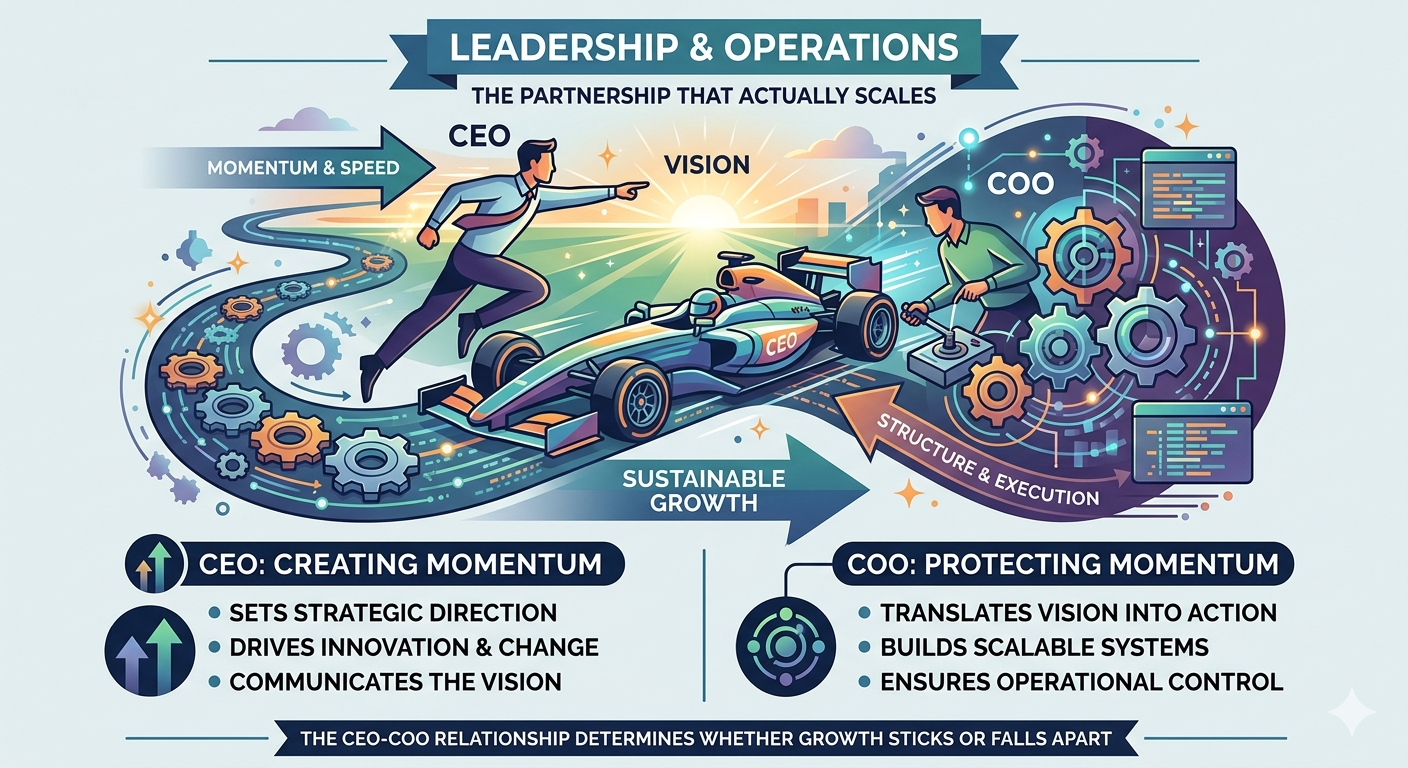
Why the CEO-COO relationship determines whether growth sticks or falls apart.
Most growing businesses hit a wall. Revenue is climbing. The team is expanding. Opportunities are coming in faster than anyone can process them. And somewhere in the middle of all of it, things start breaking.
Deadlines slip. Decisions get made without the right context. Fires that used to be small start burning longer. The leader who was once the engine of the whole operation is now the bottleneck.
This is not a hustle problem. It is not a talent problem. It is a structure problem.
Cameron Herold, one of the foremost thinkers on executive leadership, put it plainly:
A CEO pushing too hard without operational control creates chaos.
A COO slowing everything down creates stagnation.
The strongest companies grow when both roles understand the balance between speed and structure.
The CEO creates momentum.
The COO protects momentum from turning into unnecessary damage.
That distinction matters more than most leaders realize.
Speed Without Structure Is Just Chaos With a Growth Chart
Visionary leaders are wired for motion. They see the opportunity before anyone else does, they commit before the plan is fully formed, and they expect the organization to keep up. In the early days, that energy is the whole business.
But a company is not a startup forever. What works at five people does not work at twenty. What works at twenty does not work at a hundred. The founder’s pace that once felt electric starts to feel erratic. People are executing without context. Priorities shift mid-week. Resources get allocated to the loudest initiative instead of the right one.
The CEO is not doing anything wrong by moving fast. That instinct is a competitive advantage. The problem is that speed without a system to contain it will burn through people, capital, and credibility faster than revenue can replace them.
Structure Without Speed Is Just a Bureaucracy With Better Branding
On the other side of that equation is the risk of over-correction. Businesses that have survived chaos sometimes overcorrect into rigidity. Every decision requires a committee. Every process gets a process for approving the process. The organization becomes so focused on protection that it stops moving.
A COO who functions as a gatekeeper is not an operator. A COO who measures success by how many things got stopped is not solving a business problem. The role exists to enable execution, not to audit it.
Stagnation is just as dangerous as chaos. Markets do not wait for the perfect approval workflow.
What the Balance Actually Looks Like
The strongest executive partnerships work because each person understands their lane and respects the other’s. The CEO sets direction and creates urgency. The COO translates that direction into a system that can be executed at scale, consistently, without the CEO having to touch every decision.
That means the COO needs enough context to protect the vision, not just manage the workflow. And it means the CEO needs enough trust in the operational layer to let it run without constant intervention.
Neither role works without the other. A CEO with no operational infrastructure is a founder with a wish list. A COO with no strategic direction is a manager optimizing for the wrong outcomes.
The steering system metaphor holds because it captures what good operations actually do. It does not stop the car. It keeps the car from destroying itself at speed.
Why This Matters for Growing Service Businesses
Most service businesses do not have a COO. They have a founder who is also trying to be the operator, the rainmaker, the account manager, and the closer, all at once.
That works until it does not. And when it stops working, the answer is not always to hire a full-time executive. Sometimes it is to build the infrastructure those functions require, so the business can scale without everything depending on one person’s bandwidth.
The businesses that grow past the founder’s personal capacity are the ones that get deliberate about structure before they need it. They build the operational layer while momentum is on their side, not while they are already in damage control.
Adonai Business Solutions builds the operational infrastructure that growing businesses need and rarely have. If your business is outpacing its systems, that is the problem worth solving. Lets have a chat.