
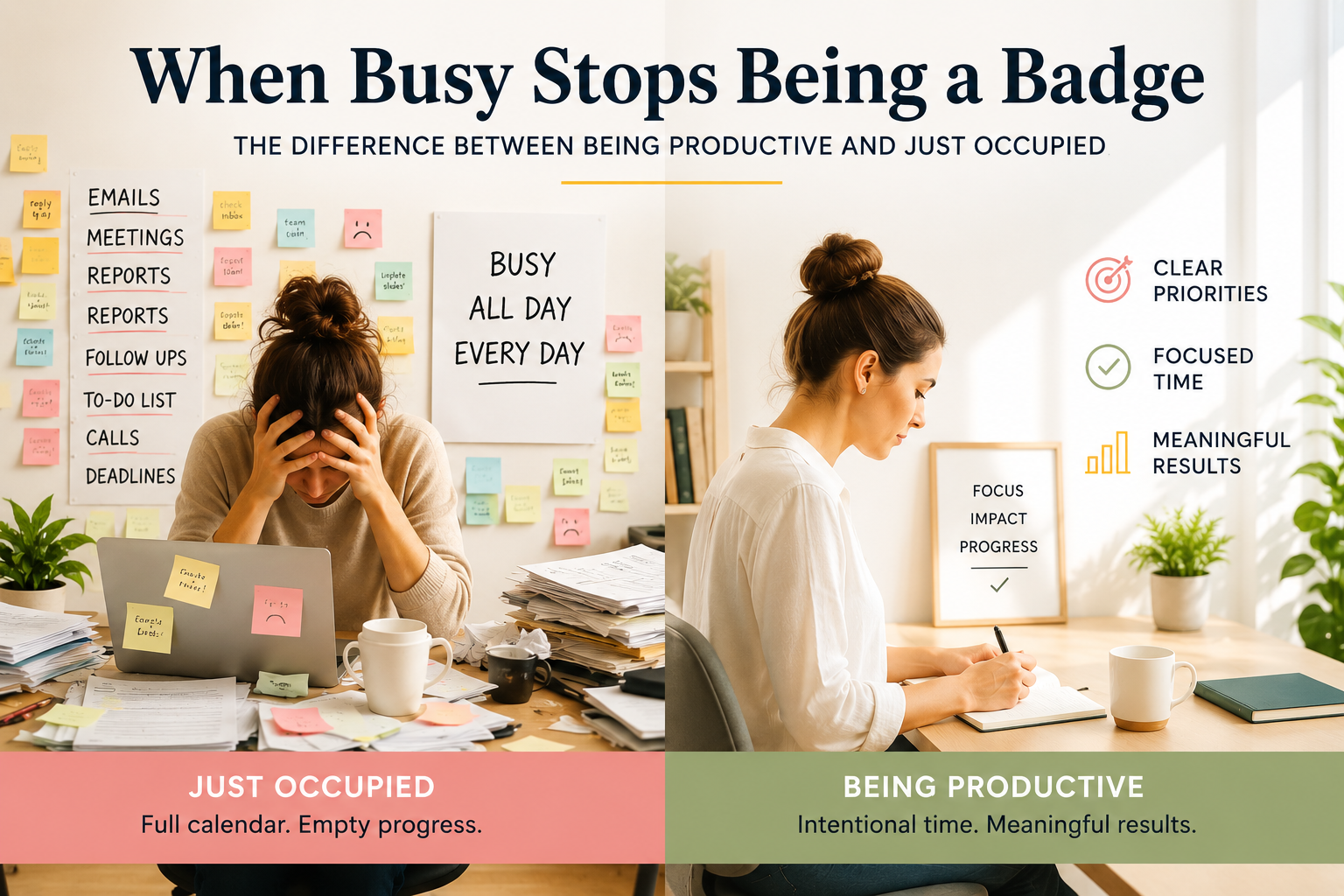
The difference between being productive and just occupied.
I used to wear busy like a trophy.
If someone asked how things were going, ‘busy’ was practically a reflex. It signaled momentum. It meant the business was alive, that people needed me, that I was doing something. It felt like proof.
It took me a while to realize that being busy is not the same as being productive. And it took me even longer to admit that sometimes, the busiest version of me was also the least effective version of me.
Busy Can Be a Hiding Place
When you are constantly in motion, you never have to sit still long enough to evaluate whether the motion is taking you anywhere worth going. The calendar stays full. The to-do list never clears. There is always something urgent pulling your attention. And because you are exhausted at the end of every day, it feels like real work.
Sometimes it is real work. But sometimes, busy is just noise dressed up as progress.
I have worked with founders who were genuinely overwhelmed and doing critical, growth-driving work. I have also worked with founders who were staying busy to avoid making decisions they were not ready to make. The difference between those two situations is not always obvious from the outside. From the inside, they feel identical.
Productive Has a Direction
Productive work moves something forward. It gets a client a result. It builds a system that did not exist before. It makes a decision that clears a bottleneck. It removes something that was slowing the business down.
Busy work keeps the wheels spinning. It fills the space. It feels necessary in the moment and leaves almost no trace a week later.
The question I started asking myself, and the question I ask my clients, is simple: if you cleared your calendar of everything you did this week, what would actually be missing? What would the business have lost? If the answer is not clear, that is worth paying attention to.
The Real Cost
‘Too busy’ is one of the most common things I hear from service business owners. And I hear it in two very different ways. Some people say it as a complaint. They want relief from the volume. They want to hand things off, slow down, build something that does not require their constant input.
Other people say it as a reason they cannot do the things that would actually solve the problem. They are too busy to document their processes. Too busy to build out their team. Too busy to step back and look at the business from the outside. Too busy to get the help that would make them less busy.
That second version is the trap. The business cannot grow past the founder’s personal bandwidth as long as the founder is the ceiling. And the only way to raise the ceiling is to carve out the time and space to build something that does not require the founder to touch every single thing.
Something Has to Change First
The shift does not start with a new tool or a new hire. It starts with being honest about what you are actually doing with your time and why.
Not every business owner is ready for that conversation. It requires looking at what is generating real results and what is generating the feeling of productivity without the substance. It requires making choices about what you stop doing, not just what you add.
But the founders who make it through the wall, who build businesses that scale past their personal capacity, almost always had a moment where they stopped treating busy as a virtue. They got quiet enough to ask whether the work they were doing was the work the business actually needed.
That question changes things.
Ready to build the infrastructure your business actually needs? Book a discovery call.